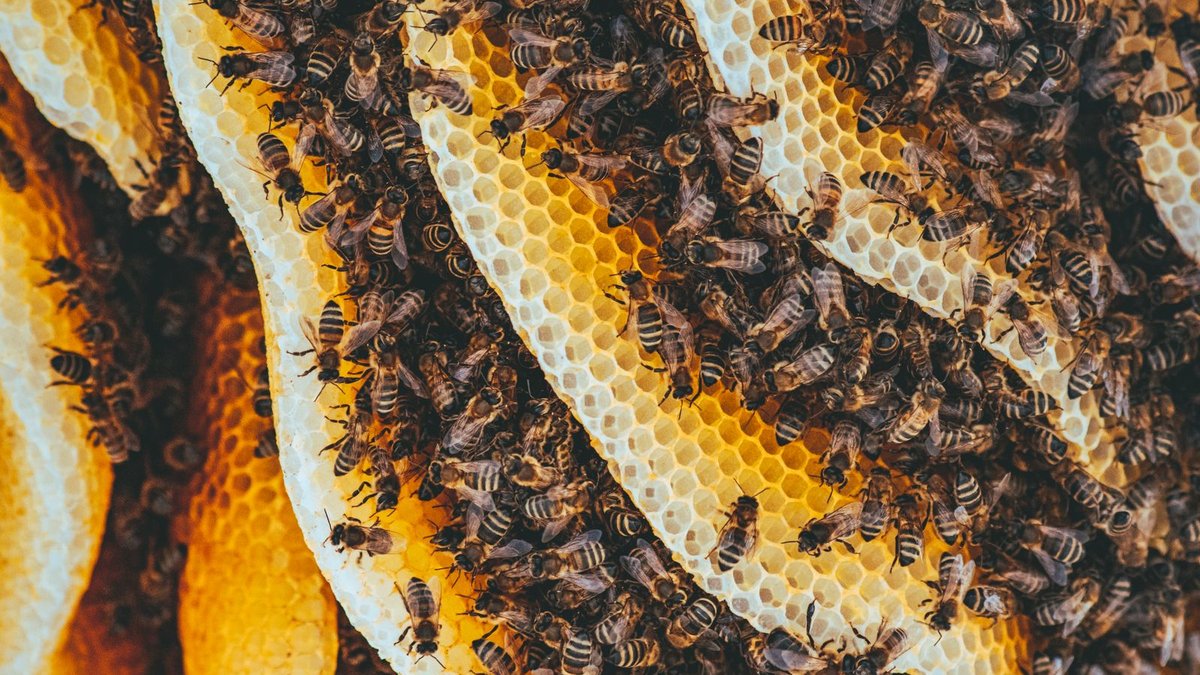
A honey bee forager who finds a rich patch of flowers does not lead her sisters to it. She flies home, climbs onto the vertical comb in the dark, and runs a small figure-eight: a straight run with her abdomen shaking side to side, a loop back, another straight run, a loop the other way. Nestmates crowd around, follow the movements, then leave to search where the dance pointed. A performance can run from one circuit to more than a hundred.
Karl von Frisch, the Austrian biologist who worked out what the movements meant, shared the 1973 Nobel Prize for the research. The code works like a miniature map: the tilt of the straight run encodes the bearing to the food, measured against the sun, and how long the run lasts encodes the distance, while vigor and scent add quality and identity.
Direction: gravity stands in for the sun
The comb hangs upright in a lightless nest, so the dancer cannot point at the sun itself and uses gravity as a stand-in. Running straight upward means the food lies sunward; a run tilted 30 degrees right of upright tells recruits to leave the hive, face the sun, rotate 30 degrees right, then fly straight. A run aimed straight down means the food lies opposite the sun.
The sun moves, so the code must move with it: von Frisch's key observation was that dancers shifted their angle through the day at the same pace as the sun. On cloudy days the sun's position can still be recovered from polarized skylight in gaps in the cloud; researchers showed in 2014 that bees which had flown under polarized light alone carried that compass information into their dances. The same sun compass steers the forager home.
Distance: the longer the run, the farther the food
Distance lives in how long the straight run lasts: more waggling means food farther away. A University of Arkansas extension guide offers a rough conversion of about a thousand yards of travel per second of waggling — an approximation, since the precise conversion differs between species and races, producing what researchers describe as regional dialects.
Close to home, the code changes shape: for food within a few metres, a forager runs in small circles, reversing direction, with little or no straight run. This round dance says food is near and worth searching for, but gives no bearing. For Italian bees it covers roughly the first 10 metres out; between 20 and 30 metres the forms grade into each other; past 40 metres the full waggle performance takes over. General extension guides draw the bands more broadly — round dance under 50 metres, crescent-shaped sickle dance for 50 to 150, waggle dance beyond 150 — since the switch-over distance varies by race and study.
An audience that feels the dance
Because the nest is dark, the western honey bee's followers cannot watch the dancer. They stay in contact with her, sensing the movements through touch, the air currents and sound her wings produce, and the electric field she carries. Each antenna carries the Johnston's organ at its base, which picks up the rhythmic pulses of air from a dancing bee; bees stop responding to those electric fields when their antennae cannot move at that joint. A University of Missouri extension guide puts it plainly: followers most likely detect air-particle movements with their antennae.
The exception proves the rule: Asia's dwarf honey bees perform on the uncovered, level crown of nests built in the open, in daylight, and their straight runs aim straight at the food, with no gravity-to-sun conversion required. Followers also pick up more than coordinates: floral scent clinging to the dancer tells recruits which blossoms to seek, and the dance carries the quality of the find, so rich patches draw the most recruits.
Getting home: a chain of cues
The dance is only half the navigation story. A forager must also find her way back to the right hive among many, using cues that hand over as she closes in: far out, the sun compass and polarized skylight; over known terrain, memorized landmarks; in the final metres, the hive's appearance and position; at the door, scent, where workers fan the lemongrass-smelling Nasonov scent while entrance guards verify each arrival's colony scent.
The landmark memory is learned, not born. A young worker, roughly three weeks old, makes brief practice flights before foraging: hovering face-on to the hive, then looping progressively wider. A 2000 study that tracked these flights with harmonic radar found seasoned bees spent roughly the same time airborne per trip but flew faster, ranging farther inside a narrow wedge of ground around the hive. In a 2023 study, 50 experienced foragers fitted with tiny radar transponders and released on unfamiliar ground followed long straight landscape features, such as irrigation channels — evidence, the researchers said, for a navigation memory, an internal chart of familiar ground. Bee vision spans ultraviolet, blue, and green, while reds are hard to separate, and plenty of blooms display nectar guides visible only in ultraviolet.
The system fails more often than people expect. A 2015 experiment arranged identical hives in a row, all entrances pointing the same direction to invite mistakes; DNA testing of 328 homecoming workers turned up 75 that belonged elsewhere — around 17 percent per colony — and the spacing between hives explained 79 percent of the drifting. Strays can bring mites and disease into the wrong colony; the usual remedies are wider spacing and distinct entrance colors.
A tool for patchy landscapes, not a fixed rule
The dance exists to recruit: it steers extra foragers toward the richest food the colony has found, and scouts use the same performance to argue for nest sites when a swarm chooses a new home. Some dances last only seconds; others run for up to five minutes. A recruit who follows the directions skips the blind search across the whole landscape.
But the dance is not always worth its cost. Researchers from the universities of Lausanne and Mainz darkened the combs and set them flat, removing the dancers' ability to indicate direction, then measured how much food the colonies gathered; in that farmland, where food was spread out and uniform, the colonies deprived of the dance language did better. Later work found bees relied on the dance more in patchy terrain — garden-filled towns, for instance — than across uniform farmland. The dance is a device the colony deploys when the return justifies it: a few seconds of movement compressing a flight into directions.