Two hundred meters beneath the surface, daylight gives up. The bright, wind-stirred top layer ends, and a cold, shadowy band takes over: the mesopelagic zone, better known as the ocean twilight zone. It runs from 200 down to 1,000 meters, circles the entire planet, and scientists estimate it may hold a greater weight of fish than every other part of the ocean put together. It is also one of the least studied habitats on Earth. Its residents rise hundreds of meters after dark, sink back at dawn, and help carry carbon from the atmosphere into the deep.
A Layer the Sun Barely Reaches
The twilight zone is sandwiched between two better-mapped neighbors. Overhead sits the epipelagic, or sunlit, zone, the top 200 meters, where nearly all entering light is found and wind churns the water, spreading warmth downward. Underneath, from 1,000 to 4,000 meters, lies the bathypelagic, a realm of permanent dark that NOAA calls the midnight zone. The mesopelagic holds the thermocline, where water temperature drops fastest with depth, giving this layer the ocean's sharpest temperature changes, according to NOAA. That boundary is most pronounced near the tropics and can all but disappear in polar winters.
Scarcity of light defines the place. Woods Hole describes a cold, dim world just past the sun's reach, broken only by brief glows of bioluminescence, light living creatures generate themselves. Sunlight-powered growth happens overhead, where phytoplankton, tiny plantlike drifters, harvest the sun's energy; most twilight-zone food drifts down from that lit world. The squeeze is extreme too: near-freezing water, and pressure climbing to fifteen hundred pounds on each square inch. Yet the zone teems with life.
A Census That Keeps Growing
Size misleads here. The typical mesopelagic fish measures just a few inches, yet the sheer numbers are staggering. Woods Hole puts the zone's fish stock above ten billion tons, plus squid, shrimp, and other invertebrates. Recent studies suggest the true fish biomass could be tenfold larger than earlier guesses, possibly exceeding the rest of the ocean's fish weight. Those are estimates from recent research, not settled counts. Residents run from microscopic bacteria and zooplankton through crustaceans and squid to soft, gelatinous animals.
One resident stands out. The bristlemouth is a pocket-sized fish whose jaws are out of proportion to its body, lined with sharp, needle-like teeth. Woods Hole describes it as possibly Earth's most abundant vertebrate, with a population that may run into the quadrillions, perhaps more individuals than any other animal with a backbone. An untold number of species in the zone still await discovery. The zone also feeds famous hunters above: satellite tags have tracked whales, sharks, tuna, and swordfish plunging deep to hunt there, tying its hidden abundance to animals people prize for food, commerce, and ecology.
The Nightly Commute
The zone's most dramatic habit came to light by accident. In the Second World War, American naval crews hunting enemy submarines kept reading a seafloor that refused to stay put: sonar showed it roughly a quarter-mile deep by day, then close to the surface at night. The wandering echo was living animals, rising after dark to feed near the surface and sinking again before sunrise.
Not every resident makes the trip, but a great many do. At nightfall, plankton, squid, fish, and assorted midwater residents climb hundreds, sometimes thousands, of feet to feed near the surface, then retreat to deeper, darker water at daybreak, beyond daytime hunters. Woods Hole calls this daily commute the planet's biggest animal migration: a living tide that rolls across every ocean once every 24 hours. The commuters also ferry carbon downward inside their own bodies, a fast track whose full scale scientists are still trying to measure.
Seeing Without Being Seen
Near-darkness has shaped bodies built around seeing and hiding. NOAA notes that this is the depth where living light starts showing up on the animals themselves. Fish here carry oversized eyes that mostly gaze upward, apparently watching for the outlines of other animals overhead in the faint glow from the surface.
Many residents answer darkness with light of their own. Woods Hole explains that creatures from microbes to jellies make their own glow through bioluminescence, to dodge predators and lure meals closer. Some small prey fish hide with counterillumination: rows of light-making organs called photophores line their undersides, matching the intensity and color of the surface light above, so from below their outline all but vanishes. Hunters flip the trick. Certain predators dangle a glowing lure, an organ called an esca, on a whisker-like barbel off the chin or back, tempting prey within striking range.
Carbon's One-Way Trip
The twilight zone matters far beyond its residents: it sits on a major route of the global carbon cycle. Roughly one in four molecules of carbon dioxide released by human activity ends up absorbed by the sea, and the twilight zone helps carry that carbon from surface water into the deep, keeping it out of the air, where it would trap heat. Woods Hole calls this chain the ocean's biological pump: phytoplankton turn carbon dioxide into tissue for growth, zooplankton graze on them, and fish eat the zooplankton, moving carbon down the food chain.
Two routes do most of the carrying. The first is marine snow: a slow blizzard of waste pellets, dead plankton, bacteria, and other debris loaded with organic carbon, sinking from the surface and feeding twilight-zone animals as it falls. The second is the nightly commute itself, moving carbon downward inside living bodies. Roughly nine-tenths of the carbon arriving in the twilight zone stays put, according to Woods Hole; only a small share sinks deeper when creatures perish or release carbon-rich waste. At those depths, carbon can stay cut off from the atmosphere for centuries, sometimes millennia.
Hard to Study, Quick to Exploit
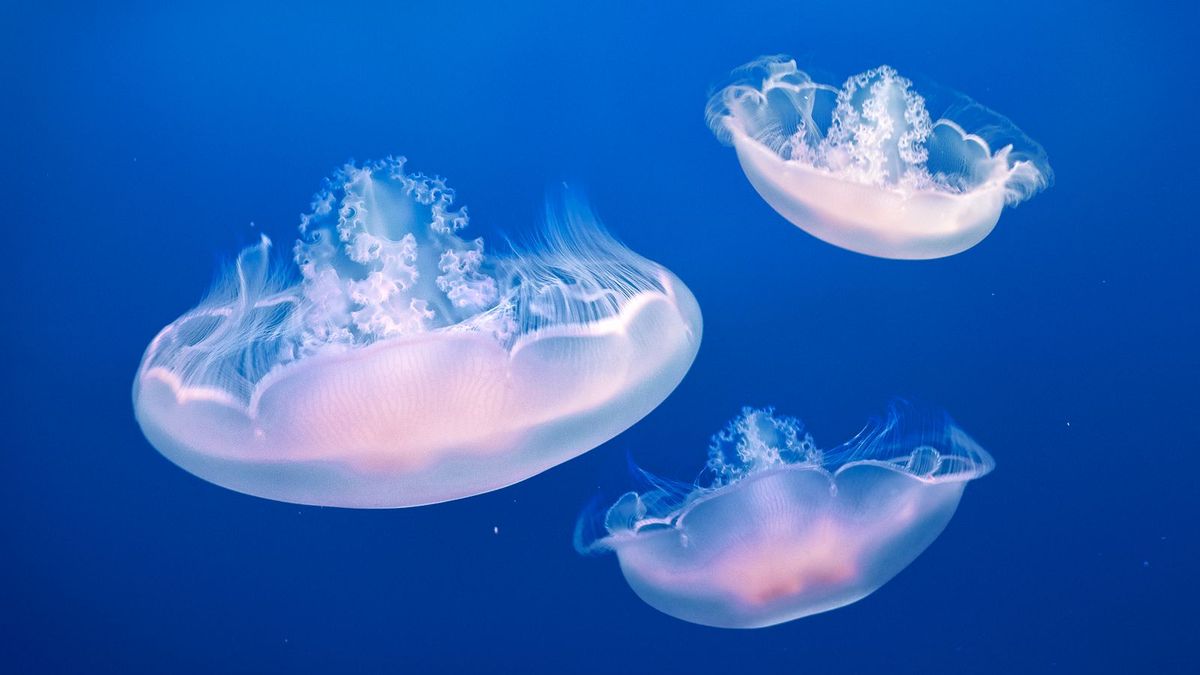
Learning more is stubbornly difficult. Satellites can survey the surface ocean, but their view stops at the top layer, and ship-based sonar struggles here too. The region is planetary in scale and restless, water and animals keep moving, and its inhabitants cluster patchily and dodge nets and vehicle-mounted cameras with ease. Soft-bodied creatures, salps, jellyfish, and siphonophores among them, disintegrate in nets and need unusual lighting to be photographed. Fundamental questions stay open: which species live there and in what numbers, how long they live, and how much carbon the nightly commute ferries downward.
Meanwhile, exploitation is arriving ahead of understanding. Factory ships already sweep up enormous hauls of small twilight-zone crustaceans, krill and copepods, most of the catch milled into meal for fish farms or rendered into pet food and nutritional oils. A few nations have granted permits to fish the zone directly, while open-ocean fisheries far from shore still operate with little regulation. Woods Hole answered in 2018 with a dedicated exploration mission, seeded with thirty-five million dollars of initial funding, to build fresh instruments, sensors, cameras, sampling gear, and apply genetic methods. Whether research can chart this layer before industry reshapes it is an open race with planetary stakes.