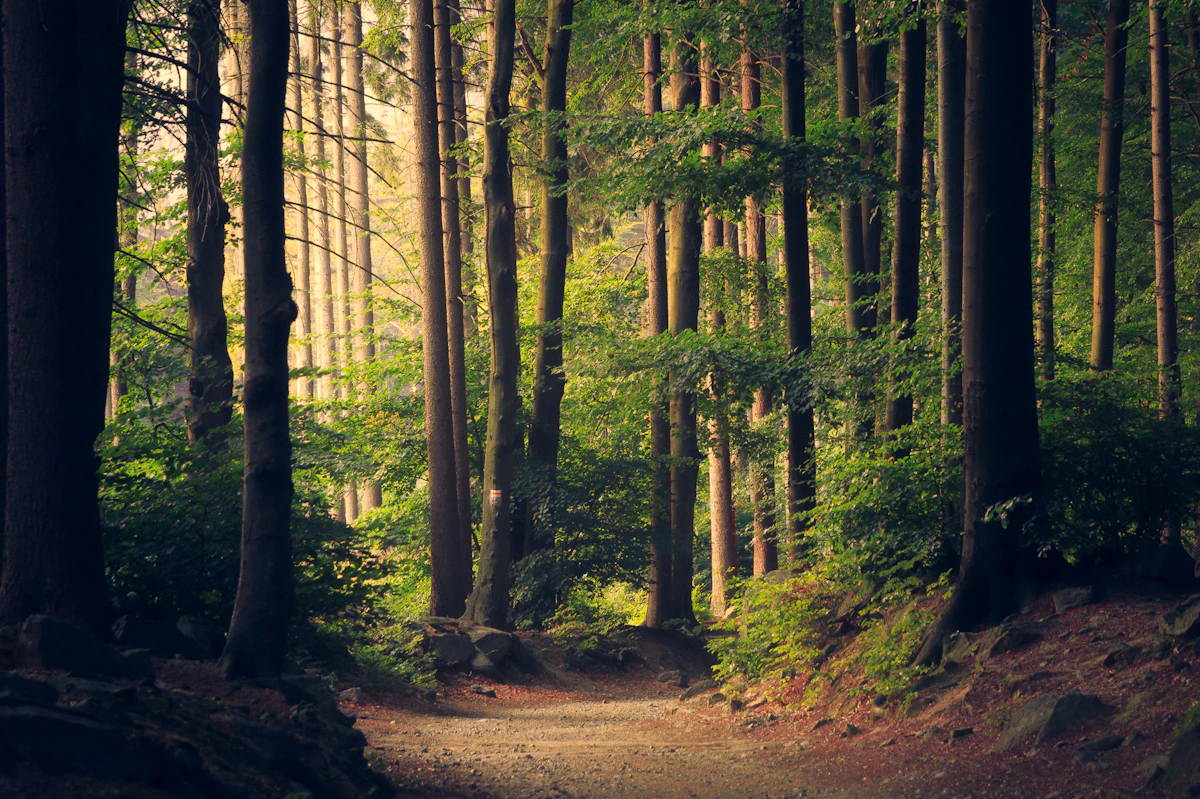
Walk through a temperate forest and you are walking above one of Earth's largest living networks. Beneath the leaf litter, microscopic fungal filaments called hyphae weave through soil, wrapping and penetrating plant roots in partnerships known as mycorrhizae. These associations are ancient, widespread, and ecologically crucial. They are also the subject of one of popular science's most seductive metaphors: the 'wood wide web,' in which trees allegedly share resources and warnings through underground fungal cables. The metaphor captures something real—and something that needs careful correction.
What Mycorrhizae Actually Are
Most land plants form mycorrhizal relationships. Arbuscular mycorrhizal fungi, belonging to the Glomeromycota, penetrate root cells and trade soil phosphorus and other nutrients for plant sugars and lipids. Ectomycorrhizal fungi, common with oaks, pines, and many other woody species, form a sheath around root tips and a Hartig net between cells. In both cases, the fungus expands the plant's effective root surface area by orders of magnitude, while the plant fuels fungal growth with photosynthetic carbon.
Common mycorrhizal networks (CMNs) arise when the same fungal individual—or genetically related mycelium—colonizes multiple plants. Carbon, nitrogen, phosphorus, and even some signaling compounds can move along hyphal pathways. Isotope-tracing experiments have repeatedly shown that labeled carbon fixed by one plant can appear in a neighbor linked by shared fungi. That much is solid science.
Where the Story Gets Ahead of the Evidence
Popular accounts often leap from 'resources can move' to 'trees altruistically feed their offspring and warn strangers of insect attack.' Ecologists have pushed back. Movement of carbon through a network does not automatically mean the donor plant intended to help, or that the recipient benefits enough to change fitness under field conditions. Fungi have their own interests: they may shuttle resources toward hosts that reward them best, not toward seedlings that humans find emotionally compelling.
"The network is real. The fairy tale of selfless trees is mostly ours."
Reviews published in recent years have argued that some high-profile claims about kin recognition, preferential nurturing of 'mother tree' offspring, and rapid alarm signaling via CMNs rest on limited, sometimes overinterpreted data. Controlled experiments that isolate fungal pathways from root grafting, soil diffusion, and volatile cues are hard to design—and when they are done carefully, results are often modest or mixed.
What Networks Do Well
Even without altruism narratives, mycorrhizal networks matter enormously. They redistribute nutrients in patchy soils, help seedlings establish in deep shade by tapping into carbon from overstory trees (whether 'gift' or fungal brokerage), and influence which plant species can coexist. Pathogens and mycorrhizal helpers interact in complex ways: some fungi protect roots from disease; others may spread parasites. Network structure—who connects to whom—shapes community assembly over decades.
Climate change research increasingly treats mycorrhizae as mediators of forest carbon balance. Drought, warming, and nitrogen deposition alter which fungal partners dominate. Because different mycorrhizal types lock up or release soil carbon at different rates, shifts in fungal communities can feed back onto atmospheric CO2. Mapping those feedbacks is now a major goal of ecosystem ecology.
Communication Without Mysticism
Plants do communicate—through airborne volatiles, root exudates, and shared enemies. When a tree is attacked by insects, neighboring plants sometimes ramp up defenses after detecting chemical cues. Whether fungal networks routinely transmit those warnings faster or farther than air or soil pathways remains an open, actively tested question. Caution here is not denial; it is the scientific method insisting on mechanisms and effect sizes.
Meanwhile, applied forestry and restoration ecology already use mycorrhizal knowledge practically. Inoculating nursery seedlings with appropriate fungi can improve survival on degraded sites. Understanding how logging, tillage, and fire fragment underground networks informs conservation of old-growth soils that took centuries to assemble.
A Clearer Picture of the Forest Floor
The wood wide web is a useful invitation to look downward. Forests are not collections of lonely trees; they are coupled plant-fungal systems whose underground architecture rivals the canopy in complexity. Celebrating that complexity does not require overstating intentionality. The evidence shows partnership, competition, and resource flow under fungal agency as much as plant strategy.
As isotope tracers, genomic surveys of soil fungi, and long-term forest plots accumulate, the story grows more nuanced—and more interesting. Reality, it turns out, does not need a fairy tale to be wondrous. The hyphae are already doing extraordinary work.